

Philosophical format
Philosophical Walk
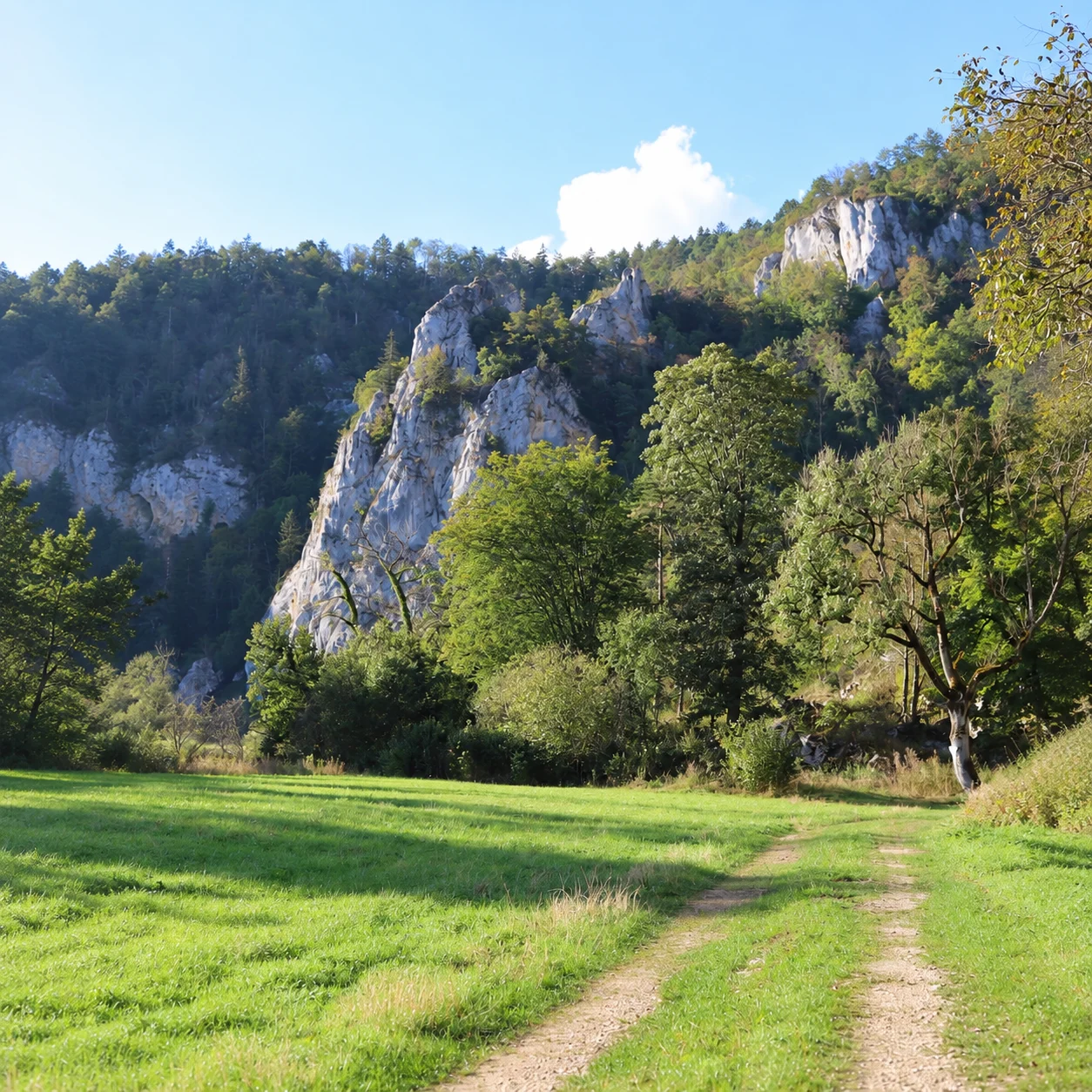
A path leads through meadows, woodland and rocks into the landscape. As the group sets out, participants may begin to notice how their perception changes: the ground beneath their feet, sounds in the surroundings, the conversation and the pauses between words. The body begins to move. Some thoughts grow quieter; others become clearer. Walking together creates a sense of community.
The starting point is a specific philosophical question: What is a good life? What does freedom mean? When is a decision just? A quotation, a short text, an image or the place itself opens the subject. As the group continues, the question may lose its initial self-evidence. New distinctions emerge, experience enters the discussion and the thought develops through dialogue.
Not everyone has to arrive at the same answer. But by the end, the question has become clearer – and each participant can take away a position of their own, supported by reasons.
What is a philosophical walk?
A philosophical walk brings together walking, the experience of nature, community and dialogue. It centres on one philosophical question. A quotation, a short text, an image or an observation introduces the subject. Along the way, participants continue thinking on their own, in pairs and as a group.
The standard Violonisto format lasts 90 minutes. The route remains manageable and does not require specialist hiking equipment. Depending on the terrain and walking pace, the maximum distance is approximately five to seven kilometres. If the conversation and the central philosophical station require more time, the route is shortened accordingly.
Walking through the history of philosophy
Plato's Academy was situated in a garden and gymnasium district beyond the gates of Athens.10 In his dialogues, Plato does not confine Socrates to indoor settings. In the Phaedrus, Socrates and Phaedrus leave the city, follow the river Ilissus and sit beneath a plane tree before their conversation begins.11 Socrates also sought conversation with people in the marketplace, workshops and gymnasia.12
Aristotle later taught in the Lyceum. The Greek term Peripatos referred to a covered walkway there; it gave rise to the name “Peripatetics” for his school. The word therefore first denotes a real place where people taught, spoke and walked – not an academic metaphor.13
Montaigne wrote that his thoughts fell asleep when he sat and that his mind would not advance unless his legs set it in motion.14 Rousseau organised his late autobiographical and philosophical reflections as ten “walks” in Reveries of the Solitary Walker.15 Kant made his daily walk a fixed part of his way of life and his regimen for health.16
Kierkegaard wrote in a letter that he had walked himself into his best thoughts.17 Thoreau made walking itself the subject of his essay Walking.18 Nietzsche held that only thoughts reached by walking have value.19 In the twentieth century, Lucius Burckhardt gave walking a different function: his science of strolling investigates how planning, habit and cultural ideas shape our perception of landscape.20
These examples do not form a single philosophical school. They represent different practices: talking with others while walking, developing thoughts in solitude, using movement as part of a health regimen, or examining one's own perception. The Violonisto philosophical walk combines three of these elements: a specific question, walking together and a structured conversation.
Purposefully open
Someone walking to work, the railway station or an appointment wants to reach a destination. On a walk, the path itself is part of the undertaking. Detours, interruptions and observations become possible. The philosophical walk adds a subject, a specific question and a prepared impulse to this openness.
The facilitator provides the temporal and thematic framework. Participants contribute experiences, objections and arguments. The outcome is not predetermined. Statements can nevertheless be examined, supported with reasons and revised in conversation. Freedom and structure each have their place.
Philosophising while walking
Walking changes a conversation. There is no need to look continuously at the person opposite, and a pause is less likely to feel like an awkward silence. Places can also become concrete prompts for thought: a fork in the path opens a question about decisions, a view changes perspective, and a ruin makes time and transience visible.
The format remains accessible. No previous knowledge of philosophy is required. What matters is attentiveness, a willingness to enter into conversation and an openness to viewing a familiar question from another perspective.
From wonder to insight of one's own
Violonisto's didactics begin in wonder. Participants first encounter a landscape, an object, an image, a piece of music or a brief scene. Inspiration follows: a quotation, a philosophical text and the necessary background information open up the subject.
During integration, specific questions relate the thought to one's own life, work or community. Perception, knowledge and experience are brought into relation. At the end, participants formulate for themselves what they have understood, what they wish to examine further and what they may want to put into practice.
Why should I do this?
Over the course of 90 minutes, the group explores a specific question, walks together, listens to different perspectives and formulates thoughts of its own. The format is suitable for a private group, an educational organisation or a team wishing to clarify a subject together while combining nature, movement and conversation.
No academic preparation is required. The subject, impulse and guiding questions are prepared; the participants' experiences and arguments shape the course of the discussion. Its value lies in understanding a question more clearly, developing a reasoned position of one's own and exchanging ideas within the group.
What begins to move when we walk
Walking sets the body – and often thought – in motion. Research indicates that walking can make it easier to generate a range of different ideas.1 Natural environments can restore attention2 and help interrupt repetitive thought.3 Regular physical activity supports health and well-being.4
Walking together adds a social dimension. Studies of walking groups suggest that shared movement can support physical and mental health.5 People encounter one another outside their usual roles, listen to different experiences and develop thoughts through conversation. The philosophical walk brings these possibilities together:
- Walking can support the development of different ideas.
- A natural environment can support attention and temporarily reduce rumination.
- A specific philosophical question gives the conversation a shared subject.
- The group makes different experiences and arguments available for comparison.
Research helps to explain important conditions of the format. The participants themselves undertake the philosophical work: they examine concepts, give reasons for statements and develop their position in dialogue.
Who is this format for?
A philosophical walk is suitable for private groups, circles of friends, associations, educational organisations and companies. The subject is adapted to the occasion, group and place. No previous knowledge of philosophy is required.
For teams, the shared path of thought can become a distinctive company event. Participants meet outside their usual work routines while still engaging with a question that may matter for cooperation, responsibility or collective action.
Tax treatment as a company event in Germany
Companies can book a philosophical walk as a company event; the related expenses are generally deductible as business expenses under German tax law.6 For the event to qualify as a company event for German wage-tax purposes, it must take place at company level and have a social character. The group of participants must consist predominantly of employees and the other persons included by the relevant tax rules.7
Further conditions apply to preferential wage-tax treatment in Germany. In principle, the event must be open to all employees of the company or a company division. Up to €110 including VAT per participating employee may receive preferential treatment for up to two company events per calendar year.8, 9 The company should discuss its particular circumstances – especially accompanying persons, external guests, additional costs and VAT – with its tax adviser.
A proven example on the Upper Danube
On 27 May 2023, Violonisto held its first larger philosophical event based on the Anthropology project. About twenty people walked from Fridingen through the landscape of the Upper Danube. At several places, quotations, portraits of authors and questions introduced the themes of home, work, pleasure, intuition, the unity of all being and self-knowledge.
Between stations, participants exchanged ideas in small groups. At the next stop, their thoughts were continued in a shared circle. A picnic, a photo shoot, signed books and a collective conclusion were also part of the day.
According to the terminology now adopted, this multi-hour event was not a single 90-minute philosophical walk but a philosophical hike or philosophical hiking day. Violonisto is using this experience to develop several clearly distinguished formats.
How a philosophical walk unfolds
The walk begins with a welcome, the subject and an initial impulse. The group then sets out together. One central station deepens the philosophical question. Along the way, perception, individual reflection, conversations in pairs or small groups and brief rounds with the full group alternate. At the end, insights, open questions and possible next steps are brought together.
The scope depends on the chosen format:
- Philosophical walk: 1 × 90 minutes
- Philosophical hike: 2–3 × 90 minutes
- Philosophical hiking day: 4 × 90 minutes
- Philosophical walking week: several days with up to four sessions per day
Breaks, distance, terrain and specific requirements are planned to suit the group. The first conversation therefore also clarifies the occasion, subject and participants' physical requirements.
At a glance
- Facilitation: One philosophical facilitator accompanies no more than twelve participants. Larger groups require additional facilitators. This ratio protects the quality of the philosophical dialogue.
- Area: The philosophical walk can be booked throughout Germany. The paths along the Upper Danube and the places featured in the book Anthropology, where the format originated, have a special connection to the project.
- Corporate fee: The standard 90-minute format costs €500. Preparation, coordination and travel to and from the event generally make it half a working day. The minimum fee for a full day is €1,000. Travel and, where necessary, accommodation, special development work and additional facilitators are itemised in the individual quotation.
- Booking: The occasion, subject, location, group size and desired scope are first clarified personally. A structured booking form is in preparation.
Questions and answers
Do I need previous knowledge of philosophy?
No. The impulses are introduced in a way that enables interested participants to think along and contribute their own experience.
Where can a philosophical walk take place?
Parks, nature trails, historic sites and other routes suited to the group and the subject are possible. The route must be manageable within 90 minutes and provide a suitable place for the shared philosophical station. It is agreed with the client beforehand.
How long does the walk last?
The standard format lasts 90 minutes. Longer events are planned as a philosophical hike, hiking day or walking week.
What happens in bad weather?
The philosophical walk takes place in all weather. Rain is part of experiencing nature and is not a reason to cancel a 90-minute event. Participants therefore need clothing and footwear suited to the weather and the agreed route. The outdoor event is cancelled as soon as the German Weather Service issues an official weather warning for its location and scheduled time.21 Without an official warning, rain, cold or other uncomfortable weather is not a reason for cancellation.
Warnings are checked on the evening before the event and again three hours before it begins. Preliminary severe-weather information leads to consultation with the client but does not by itself constitute a cancellation. If an immediate danger develops unexpectedly at the location, or the route is closed by the authorities, the facilitator may also interrupt or end the event.
If the client wishes, a version for a suitable indoor space can be arranged. This is an available alternative but not the standard format.
Which subjects are possible?
Questions from the Violonisto projects are possible, as is a jointly developed subject suited to the occasion and the group.
Enquire about a philosophical walk
A philosophical walk begins with a question. Together, we develop a subject, a suitable route and a sequence that fits the group and the occasion.
Tell us briefly who the walk is for, where it should take place and which question concerns you. We will clarify everything else personally.
Enquire about a philosophical walk
Literature
- Walking and generating ideas: In four experiments, participants frequently performed better at generating different ideas while walking than while sitting.Oppezzo, Marily, and Daniel L. Schwartz. “Give Your Ideas Some Legs: The Positive Effect of Walking on Creative Thinking.” Journal of Experimental Psychology: Learning, Memory, and Cognition 40, no. 4 (2014): 1142–52. https://doi.org/10.1037/a0036577.
- Nature and attention: Two experiments associated contact with nature with improved performance in tests of directed attention.Berman, Marc G., John Jonides, and Stephen Kaplan. “The Cognitive Benefits of Interacting With Nature.” Psychological Science 19, no. 12 (2008): 1207–12. https://doi.org/10.1111/j.1467-9280.2008.02225.x.
- Walking in nature and rumination: After a 90-minute walk in a natural environment, participants reported less rumination than after a walk along a busy road.Bratman, Gregory N., J. Paul Hamilton, Kevin S. Hahn, Gretchen C. Daily, and James J. Gross. “Nature Experience Reduces Rumination and Subgenual Prefrontal Cortex Activation.” Proceedings of the National Academy of Sciences 112, no. 28 (2015): 8567–72. https://doi.org/10.1073/pnas.1510459112.
- Regular physical activity: The WHO includes walking as physical activity and identifies benefits for physical and mental health, cognitive function, mobility and quality of life.World Health Organization, Regional Office for Europe. “Everyday Actions for Better Health – WHO Recommendations.” 17 July 2025. https://www.who.int/europe/news-room/fact-sheets/item/everyday-actions-for-better-health-who-recommendations.
- Walking together: A systematic review of 42 studies involving 1,843 participants found improvements in several physical health measures and depression scores among walking groups.Hanson, Sarah, and Andy Jones. “Is There Evidence That Walking Groups Have Health Benefits? A Systematic Review and Meta-Analysis.” British Journal of Sports Medicine 49, no. 11 (2015): 710–15. https://doi.org/10.1136/bjsports-2014-094157.
- Business expenses in Germany: Expenses for company events are generally deductible as business expenses.Haufe Online Redaktion. “Betriebsausgaben-ABC: Betriebsveranstaltungen.” Accessed 30 October 2026. https://www.haufe.de/id/beitrag/betriebsausgaben-abc-betriebsveranstaltungen-HI7025090.html.
- Definition of a company event: Under German tax rules, the group must consist predominantly of employees, their accompanying persons and, where applicable, temporary workers or employees of affiliated companies.Haufe Online Redaktion. “Betriebsveranstaltung: Definition und Abgrenzung.” Accessed 30 October 2026. https://www.haufe.de/personal/entgelt/betriebsveranstaltungen/betriebsveranstaltung-definition-und-abgrenzung_78_429212.html.
- €110 allowance: Section 19 of the German Income Tax Act governs the allowance per participating employee, access for all members of the company or company division and the limit of two preferential events per year.German Federal Ministry of Justice. “Einkommensteuergesetz (EStG), § 19.” Accessed 30 October 2026. https://www.gesetze-im-internet.de/estg/__19.html.
- Calculation and individual questions: The official German wage-tax guidance addresses eligible persons, calculation of the allowance, accompanying persons and VAT treatment.German Federal Ministry of Finance. “Lohn- und umsatzsteuerliche Behandlung von Betriebsveranstaltungen.” Lohnsteuer-Handbuch 2026. Accessed 30 October 2026. https://lsth.bundesfinanzministerium.de/lsth/2026/B-Anhaenge/Anhang-11a/anhang-11a.html.
- Plato’s Academy: The ancient account places the Academy in a gymnasium and garden district outside Athens.Diogenes Laertius. Lives of Eminent Philosophers. Book III, sections 5–7.
- The walk in the Phaedrus: Socrates and Phaedrus leave Athens on foot, follow the Ilissus and choose a plane tree as the place for their conversation.Plato. Phaedrus. 227a–230e.
- Socrates in public space: Xenophon describes Socrates speaking with people in gymnasia, the marketplace and other public places during the morning and throughout the day.Xenophon. Memorabilia. Book I, chapter 1, section 10.
- Aristotle and the Peripatos: The ancient account connects Aristotle’s school in the Lyceum with the Peripatos, the covered walk.Diogenes Laertius. Lives of Eminent Philosophers. Book V, sections 1–2.
- Montaigne: Montaigne states directly that his thoughts fall asleep when he sits and are set in motion by the movement of his legs.Montaigne, Michel de. “De trois commerces.” In Essais, book III, chapter 3. 1588.
- Rousseau: Rousseau organises his autobiographical and philosophical reflections as ten walks.Rousseau, Jean-Jacques. Les Rêveries du promeneur solitaire. 1782.
- Kant: Kant discusses walking in connection with his personal regimen for health.Kant, Immanuel. Der Streit der Fakultäten. Königsberg: Friedrich Nicolovius, 1798. Third section.
- Kierkegaard: Kierkegaard writes that he had walked himself into his best thoughts.Kierkegaard, Søren. Letter to Henriette Kierkegaard, 1847. Letter no. 150.
- Thoreau: Thoreau treats walking as a distinct intellectual and social practice.Thoreau, Henry David. “Walking.” The Atlantic Monthly 9, no. 56 (June 1862): 657–74.
- Nietzsche: Nietzsche explicitly connects the value of a thought with its origin in walking.Nietzsche, Friedrich. Twilight of the Idols. “Maxims and Arrows,” no. 34.
- Burckhardt: The science of strolling investigates, through walking, how landscape is perceived, planned and interpreted through culture.Burckhardt, Lucius. Warum ist Landschaft schön? Die Spaziergangswissenschaft. Edited by Markus Ritter and Martin Schmitz. Berlin: Martin Schmitz Verlag, 2006.
- Official weather warnings: The philosophical walk follows a simple rule: weather without an official warning from the German Weather Service is not a reason for cancellation. As soon as an official warning applies to the place and time, the outdoor event is cancelled.Deutscher Wetterdienst. Wetterexperten vor Ort: Wetter- und Unwetterwarnungen des Deutschen Wetterdienstes. Offenbach am Main: Deutscher Wetterdienst, 2021. https://www.dwd.de/SharedDocs/broschueren/DE/presse/wetterwarnungen_pdf.pdf.